
The story followed Joni, an ambitious corporate employee who found himself at a sudden career standstill. Having found himself in a fierce internal competition to become the next CEO, he was unexpectedly suspended from his firm. Refusing to accept his fate, he returned to his roots and discovered a struggling roof-tile factory. To save the business, Joni formulated a bizarre yet brilliant marketing scheme.
By the second episode, Joni’s desperation had turned into creativity. He decided that the best way to gain viral popularity was to host a local bodybuilding competition entitled ‘Kontot’ (Kontes Otot/Muscle Contest). However, the road was far from smooth as he lacked resources and faced scepticism from the locals. In the third episode, the conflict intensified when his initial proposals were rejected, leading to a series of comedic misadventures involving a local herbal tonic known as purwoceng to boost the contestants’ morale and physique.
The series explores the theme of modern job hunting and corporate survival, contrasting it with lower entrepreneurship. It delves into the power of viral culture and social media as a tool for economic redemption. Additionally, there is a strong undercurrent of community and brotherhood, showing how a shared goal can unite a group of underdog characters.
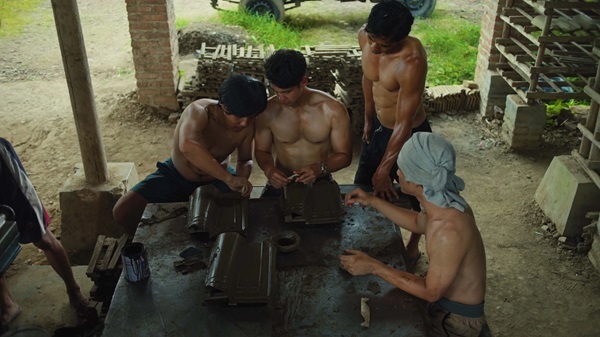
In my view, ‘Ganteng-Ganteng Genteng’ succeeds because it does not take itself too seriously. The lead’s ability to change from a polished corporate man to a frantic project manager of a rural muscle show is interesting. The dialogue is filled with local Indonesian puns and satirical takes on ‘viral’ trends. The show uses colourful objects that match its energetic comedic tone. The music punctuates many scenes, emphasising the absurdity of the ‘Kontot’ event.
The show’s strength lies in its unique premise. Using a bodybuilding contest to save a roof-tile factory is a breath of fresh air in the saturated market of romantic dramas. The pacing is fast, keeping the audience engaged through the first three episodes. However, its weakness lies in its reliance on slapstick humour, which may feel repetitive. The secondary characters also feel like caricatures rather than fully fleshed-out individuals.
The core message of the series is that resilience often requires thinking outside the box. It suggests that failure is often just a detour towards a more creative venture.
*Ramdhan Asysyakur is a Computerized Accounting student at Politeknik LP3I Jakarta